Light & Exposure
How to Shoot in a Dark Room and Keep Your Cool
A calm, repeatable plan for low-light sessions that starts with the light you have—not the gear you wish you had.
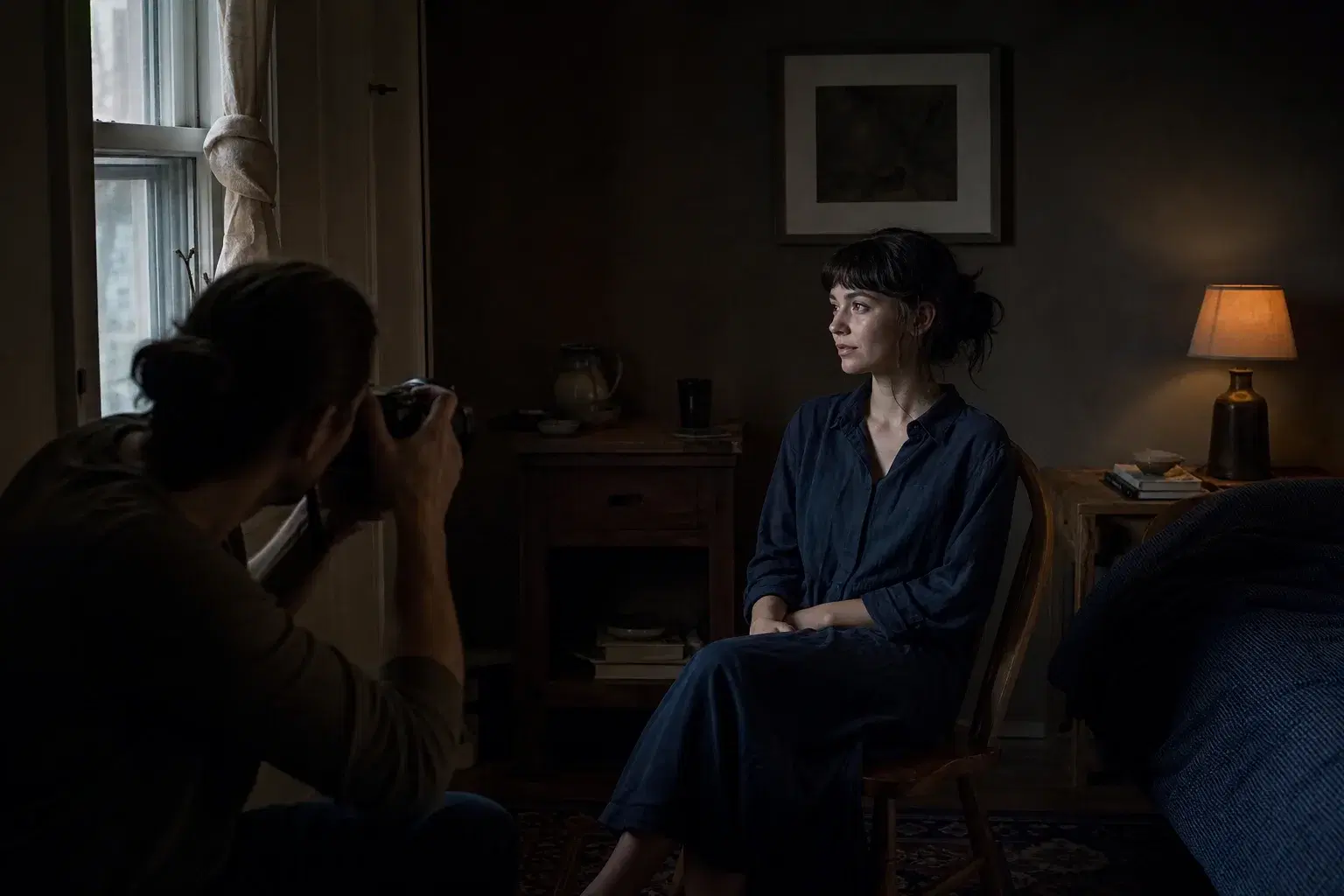 FIELD NOTE / Light & Exposure
A dark room is not a bad location. It is a location with a smaller lighting budget. Slow down, find the light that is actually helping, and decide how much movement the photograph needs to hold.
Find the light that is earning its keep
Turn off mixed overhead lights for a moment and look for windows, doorways, lamps, candles, signs, or light bouncing from a pale wall. Move your subject closer to the strongest useful source and rotate them until the face has shape. Congratulations: the room has a plan now.
The closer a subject is to a small source, the faster the light falls away. That can create drama, but it can also make small movements change the exposure. Give yourself room when consistency matters.
Save the shutter speed first
In low light, motion blur often spoils a frame before noise does. Choose a shutter speed for the subject’s movement, not just the focal length on the lens.
- Still portrait: begin around 1/160 second.
- Conversation or gentle movement: try 1/250 second.
- Dancing, children, or quick gestures: use 1/400 second or faster.
Then choose the aperture for the depth of field you need and raise ISO to complete the exposure.
Open up, but not blindly
Opening a lens to f/1.4 lets more light reach the sensor, but it also gives you very little depth of field. For two people on slightly different planes, f/2 or f/2.8 may produce more keepers. A brighter frame is not much of a victory if the wrong set of eyes is sharp.
Become a reasonably good human tripod
Plant your feet, tuck your elbows, exhale gently, and make short bursts instead of holding the shutter continuously. Image stabilization helps with camera movement, but it cannot freeze a moving subject. Physics remains stubborn on this point.
When the scene allows it, a monopod, tripod, wall, or table can buy a slower shutter speed. Check whether that slower speed still matches the photograph you are making.
Add light with a reason
A small bounced flash can lift a room without making it look flashed. Aim at a neutral wall or ceiling and keep the ambient exposure present. If the ceiling is very high, dark, or strongly colored, use a compact off-camera light or move closer to existing light instead.
Match the light to the mood. A dark room does not need to audition for the role of noon.
A setup to use before panic arrives
Start in manual exposure with a shutter speed safe for the subject, the widest aperture that keeps the needed faces sharp, and Auto ISO capped at a level your camera handles well. Make a frame, check highlights and motion, then adjust one variable at a time. No button-mashing required.
Low-light confidence comes from protecting the moment first and polishing the file second.